Boston to New York City covers 215 miles of interstate driving. The trip takes approximately four hours in light traffic and closer to five and a half hours during weekday rush hour. Most drivers take I-90 West out of Boston, connect to I-84 South near Sturbridge, then follow I-95 South through Connecticut into Manhattan.
The Exact Drive Numbers Most Travelers Actually Want
If you have wondered how far Boston is from New York by car for planning a corporate trip, a family visit, or a scheduled airport connection, the answer is 215 miles from downtown Boston to Midtown Manhattan. Drivers leaving from Cambridge or Newton shave five to eight miles off the total. Departures from Logan International Airport add three miles heading west through the Ted Williams Tunnel.
Trip length depends far more on traffic than on route choice, since all realistic paths between the two cities converge on I-95 South through Connecticut by mile 90. Total fuel consumption for a standard sedan runs eight to nine gallons at highway efficiency, before city driving on either end.
Route Mileage Broken Down By State
The driving distance from Boston to New York splits across four states with predictable mile counts on each segment. Massachusetts covers the first 50 miles from Boston to the Connecticut border, running through Framingham, Worcester, and Sturbridge along the Mass Pike. Connecticut carries the heaviest share of the Boston to New York distance at roughly 110 miles from the state line to the New York border near Greenwich, passing Hartford, Meriden, New Haven, and Bridgeport.
New York contributes 40 miles from the state line to Midtown Manhattan, running through Westchester County and the Bronx. The final 15 miles of the Boston to New York mileage cross the Bronx and enter Manhattan across the Third Avenue Bridge, the Willis Avenue Bridge, or the RFK Bridge, depending on your Manhattan destination.
What Is The Typical Boston to NYC Driving Time In Real Traffic?
A weekday departure from Boston at 4 a.m. reaches Manhattan by 8 a.m. under normal conditions. That is the light-traffic baseline. The Boston to NYC driving time stretches to five hours if you leave between 6 and 8 a.m. because of stacked congestion around Hartford, the Merritt Parkway split near Stamford, and the Cross Bronx heading into Manhattan. Sunday afternoon returns from New York to Boston frequently run five and a half to six hours because of I-95 volume through Connecticut.
Overnight departures between 10 p.m. and 2 a.m. hit the fastest Boston to New York drive time in traffic, often finishing under four hours. The number of miles from Boston to New York never changes, but a 90-minute swing in drive time based on departure hour is common on this corridor.
How far is Boston to New York By Car on Different Route Options
Three practical Boston to New York route options exist, and each one changes drive time more than distance. The fastest route from Boston to New York for most departures is I-90 to I-84 to I-95, which is Google Maps’ default recommendation and clocks in at 215 miles. Boston to New York via I-95 the entire way through Providence adds 15 to 20 miles, but avoids the Hartford interchange during peak morning hours.
The third option runs from I-90 to I-84 to the Merritt Parkway from Milford onward, which shaves 20 minutes of stress off the Connecticut leg but adds tolls and bans commercial vehicles. Private Boston to NYC car service defaults to whichever path shows the least red on live traffic at departure, since a locked flat-rate quote means the chauffeur absorbs any route change without a price adjustment.
- I-90 to I-84 to I-95 South: 215 miles, four hours in light traffic
- I-95 South the entire way via Providence: 230 miles, avoids Hartford
- I-90 to I-84 to Merritt Parkway: 220 miles, no trucks, extra tolls
- Overnight I-90 to I-84 to I-95: fastest actual clock time, under four hours
- All routes converge on I-95 South by the Connecticut-New York border
Boston to New York Distance Broken Into Hour-by-Hour Segments
Hour one covers 60 miles from downtown Boston through Framingham, Worcester, and into Sturbridge, where I-90 meets I-84. Hour two runs 55 miles down through Union, Vernon, and East Hartford, hitting the Hartford interchange on the Boston to New York via Hartford path. Hour three covers 55 miles through Meriden, Wallingford, and Boston to New York via New Haven, onto the New Haven merge with I-95.
Hour four handles the final 45 miles through Bridgeport, Stamford, Greenwich, the Bronx, and into Manhattan across whichever bridge lines up with the drop-off address. That segmented breakdown of the Boston to New York distance is the reason rest stop timing matters. A 90-minute driving stretch between rest breaks lands most drivers at the New Haven service area for the halfway point.
Rest Stops, Gas, and Food Along the Route
Three major service plazas serve the Boston to New York road trip corridor between the two cities. The Charlton Service Plaza in Massachusetts sits at mile 40 westbound with fuel, a food court, and Tesla Superchargers. The Fairfield Service Plaza in Connecticut at mile 150 southbound is the most-used halfway stop for southbound travelers, though it gets crowded on Sunday afternoons. Milford Service Plaza at mile 175 offers a less-crowded alternative closer to the state border. Boston to New York rest stops between these three points are limited on the I-84 stretch, so most drivers plan around them.
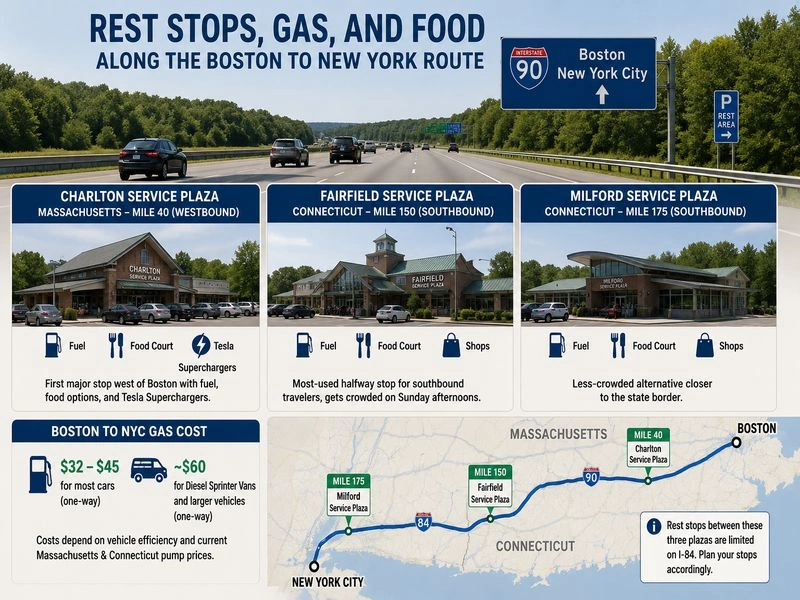
Boston to NYC gas cost runs $32 to $45, depending on vehicle efficiency and current Massachusetts and Connecticut pump prices. Diesel Sprinter Vans and larger vehicles budget closer to $60 for the one-way trip.
Bridge and Highway Tolls on the Standard Route
Tolls on the standard route add roughly $18 to $28 one-way in a passenger vehicle with electronic toll payment. The Massachusetts Turnpike segment charges $6.85 from Boston to Sturbridge. Connecticut is toll-free on I-84 and I-95, which is unusual for a Northeast Corridor state. New York collects tolls on all three East River-adjacent Bronx bridges and the George Washington Bridge if your route uses it, though the standard Boston to NYC driving time route stays east of the GWB.
Driving from Boston to Manhattan across the RFK Triangle Bridge costs around $11.19 with E-ZPass. Cash rates run higher. Toll totals affect Boston to New York tolls math significantly if you take the Merritt Parkway variant, which stacks Connecticut parkway tolls on top of the New York City bridge charge.
- Massachusetts Turnpike: $6.85 with E-ZPass, Boston to Sturbridge
- Connecticut interstates: no tolls on I-84 or I-95 through the state
- RFK Triangle Bridge into Manhattan: $11.19 with E-ZPass
- Whitestone or Throgs Neck Bridge: $11.19 with E-ZPass for JFK access
- Merritt Parkway variant: adds parkway tolls but avoids I-95 congestion
How Far is Boston to New York By Car in Winter Conditions
Winter driving adds real time to the Boston to NYC corridor even when snowfall is moderate. A dusting in Hartford routinely doubles the drive time between mile 100 and mile 130 because trucks slow down in the middle two lanes on I-84 heading toward the interchange. Boston to NYC winter driving windows also extend because of state DOT plow patterns. Massachusetts pretreats the Mass Pike aggressively, Connecticut plows in real time, and New York clears the Cross Bronx last during regional storms.
The Merritt Parkway shuts to commercial traffic in winter storms and sometimes fully closes, forcing all southbound flow onto I-95. Realistic winter drive time between Boston and New York runs five to seven hours in a moderate snowstorm and eight to ten hours in a full nor’easter along the corridor.
Planning a Boston to New York Road Trip Beyond the Drive itself
A well-planned Boston to New York road trip accounts for more than the four-hour drive. Timing your departure is the single biggest variable. Leaving Boston at 5 a.m. or 1 p.m. gives you the cleanest interstate flow. Leaving at 7 a.m. or 4 p.m. adds an hour minimum. Parking on the Manhattan end is the second variable most drivers underestimate. Overnight garages in Midtown run $60 to $95 per night. Street parking in most residential neighborhoods requires a permit or has weekday cleaning restrictions that turn a legal spot into an $115 ticket by Tuesday morning.
Boston to New York via Merritt Parkway is worth considering for the return leg because on Sunday, I-95 traffic through Connecticut northbound routinely exceeds five hours by itself. Chauffeur-driven limo service from Boston to New York eliminates both variables from the planning entirely.
What Most Travelers Should Know Before Making the Drive
If you have been researching how far it is from Boston to New York by car to decide between driving yourself, taking Amtrak, or booking a chauffeur, the four-hour drive is only the surface answer. Fatigue on the return leg, unpredictable Connecticut traffic, Manhattan parking costs, and the loss of four working hours in each direction are what most travelers factor in after their first solo drive.
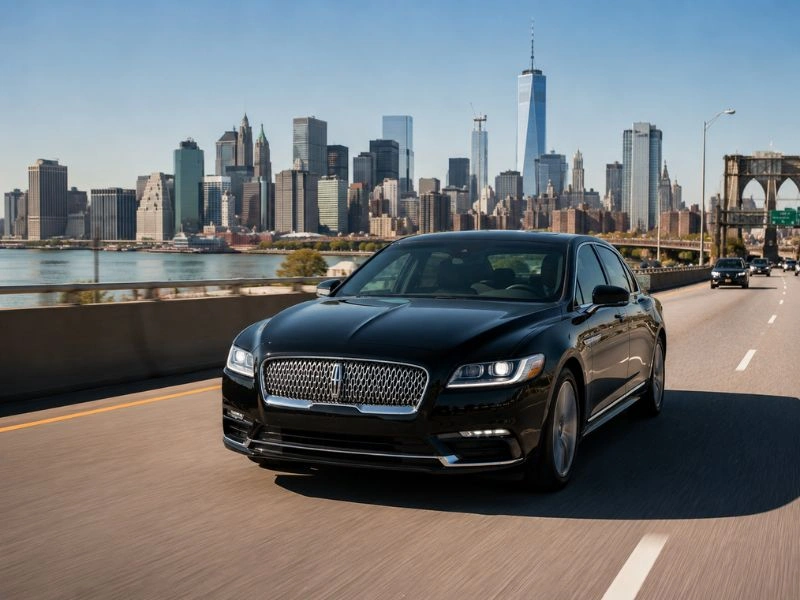
Blue Nile Livery runs this exact route every day of the week and knows the corridor well enough to plan around Hartford before Hartford happens. For a one-way run, the flat-rate chauffeur option often works out cheaper than an Amtrak Acela business-class ticket plus a Manhattan taxi to your final address. Call (877) 307-2322 for a direct quote or book online at bluenilelivery.com/reservation.
FAQs
How many miles is it from Boston to New York City?
The driving distance is 215 miles from downtown Boston to Midtown Manhattan. Departures from Cambridge or Newton run five to eight miles shorter. Departures from Logan Airport add three miles because of the Ted Williams Tunnel routing.
How long does it take to drive from Boston to New York?
Approximately four hours in light traffic. Weekday morning and evening peaks push the drive to five hours. Sunday afternoon returns northbound frequently run five and a half to six hours due to I-95 volume through Connecticut.
What is the fastest route from Boston to New York?
The default I-90 West to I-84 South to I-95 South route is the fastest under most conditions at 215 miles. Overnight departures between 10 p.m. and 2 a.m. have the shortest actual clock time, often under four hours.
How much do tolls cost when driving from Boston to NYC?
Tolls run $18 to $28 one-way with E-ZPass in a passenger vehicle. That includes the Massachusetts Turnpike and one Manhattan-approach bridge. The Merritt Parkway variant adds parkway tolls on top of that base.
Is it worth driving from Boston to New York versus taking the train?
The 215-mile drive gives door-to-door flexibility that Amtrak does not. Driving yourself costs four hours of your attention each way. A chauffeured car gives you door-to-door plus the working hours back. Amtrak Acela is the fastest for business district to business district.